📖 B. INTRODUCTION
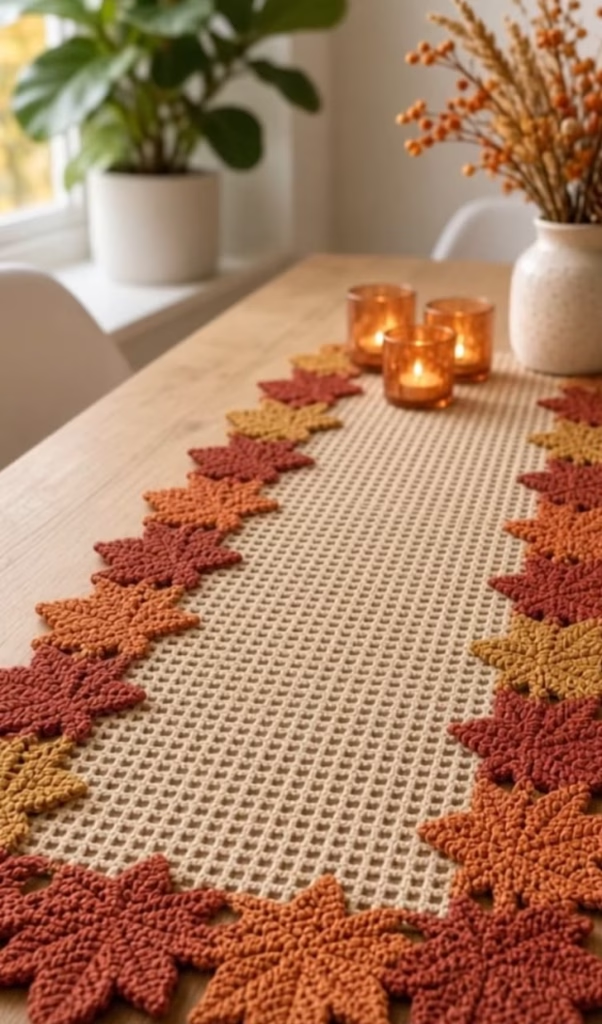
Bring the vibrant warmth of rich autumn foliage right to your dining room or entryway table with this Fall Harvest Maple Leaf Table Runner. Designed with a striking contrast between a crisp, neutral filet mesh center and a lush, cascading border of multi-tonal maple leaf motifs, this handmade piece captures the cozy essence of fall. The airy grid center provides an elegant backdrop, allowing the rich shades of mustard, pumpkin, terracotta, and burgundy along the edges to truly pop.
Whether you are dressing your table for Thanksgiving dinner, decorating a mantel for the season, or crafting a memorable housewarming gift, this runner serves as a timeless autumn centerpiece. The classic maple leaves overlap gracefully along the long borders, creating a scalloped, organic silhouette that mimics freshly fallen leaves on a crisp October afternoon.
Because the design relies on modular leaf motifs joined to a central mesh base, it offers incredible flexibility. You can easily adjust the total length to fit everything from a compact sideboard to a extended dining table that seats twelve. Experiment with yarn shades—from classic rustic warm tones to modern muted pastels—to perfectly match your home decor aesthetic.
🔍 C. MAIN PATTERN OVERVIEW
The Fall Harvest Maple Leaf Table Runner consists of two primary components worked independently and joined during final assembly:
- 🕸️ The Central Grid Base: A clean, rectangular filet mesh panel worked flat in turned rows using a crisp ecru or cream cotton yarn. A single-crochet border is worked around the entire perimeter to establish clean, sturdy edge stitches.
- 🍁 The Maple Leaf Motifs: Individual 5-point maple leaf motifs crocheted in four distinct fall colors. Each leaf features a textured center, radiating vein structures created through varied stitch heights (sc, hdc, dc, tr, and dtr), and pointed tips formed by picot stitches.
Once the base and individual leaves are complete, the leaves are blocked to point perfection, joined into continuous overlapping side trims, and securely attached along the long edges of the central runner.
🎯 D. SKILL LEVEL
Skill Level: Intermediate
While the central mesh runner is beginner-friendly, shaping the intricate maple leaf motifs requires working in the round, switching between stitches of varying heights, working picot tips, and executing precise motif assembly and wet blocking.
Required Techniques:
- Basic stitches: Single crochet (sc), Half double crochet (hdc), Double crochet (dc), Treble crochet (tr), Double Treble crochet (dtr).
- Working in the round using a Magic Ring (MR).
- Picot stitch shaping.
- Working in turned rows (for the central mesh).
- Seaming motifs using a tapestry needle (whip stitch or mattress stitch).
- Wet blocking techniques for motif shaping.
📏 E. FINISHED SIZE
- Width: Approx. 15.5 inches (39.5 cm) from leaf tip to leaf tip across.
- Length: Approx. 48 inches (122 cm) from end to end.
- Mesh Base Width: Approx. 11.5 inches (29 cm).
Note on Sizing: You can easily customize the runner length by adding or subtracting rows from the central mesh base in increments of 2 rows, adding 2 additional leaves (one per side) for every ~3 inches (7.5 cm) of added length.
🧮 F. GAUGE
- Filet Mesh Base Gauge: 9 mesh spaces (
dc + ch 1) and 9 rows = 4″ x 4″ (10 cm x 10 cm) unblocked using a 3.75 mm (US F/5) hook. - Maple Leaf Motif Gauge: 1 individual blocked maple leaf measures approximately 3.75 inches wide x 3.75 inches tall (9.5 cm x 9.5 cm) from central leaf tip to stem base.
Tension Note: Exact gauge is not critical for this decorative item, but maintaining consistent tension ensures that all leaves turn out uniform in size and line up neatly along the runner edge.
🧶 G. REQUIRED YARN AMOUNTS
For best results, structural stability, and crisp stitch definition, use a 100% Mercerized Cotton or Combed Cotton yarn in DK / Light Worsted (Weight 3).
- 🧶 Main Color (Cream/Ecru Base): Approx. 450 yards (410 meters) / 200g
- 🟡 Leaf Color A (Mustard Yellow): Approx. 110 yards (100 meters) / 50g
- 🟧 Leaf Color B (Pumpkin Orange): Approx. 110 yards (100 meters) / 50g
- 🧱 Leaf Color C (Terracotta Rust): Approx. 110 yards (100 meters) / 50g
- 🍷 Leaf Color D (Burgundy Red): Approx. 110 yards (100 meters) / 50g
Total Project Yarn:* Approx. 890 yards (810 meters).
🧰 H. MATERIALS
- 🪡 Crochet Hook: Size US F/5 (3.75 mm) or US E/4 (3.5 mm) depending on yarn tension.
- ✂️ Scissors: Sharp craft or yarn scissors.
- 🧶 Tapestry Needle: Blunt-ended yarn needle for seaming and weaving in ends.
- 📍 Blocking Supplies: Blocking mat/board, stainless steel rust-proof T-pins, and a spray water bottle (essential for opening up leaf points).
- 🏷️ Stitch Markers: 4–8 locking stitch markers for alignment during assembly.
🔤 I. ABBREVIATIONS – US TERMS
- ch: chain
- sl st: slip stitch
- sc: single crochet
- hdc: half double crochet
- dc: double crochet
- tr: treble crochet (YO twice)
- dtr: double treble crochet (YO 3 times)
- picot: ch 3, sl st into 3rd ch from hook
- top-picot: ch 4, sl st into 4th ch from hook (for main central tip)
- MR: magic ring
- st(s): stitch(es)
- sp(s): space(s)
- YO: yarn over
- FO: fasten off
📝 J. NOTES BEFORE YOU BEGIN
- Yarn Selection: Cotton yarn is highly recommended over acrylic for table runners. Cotton lays flat, resists curling, and holds shape remarkably well when blocked.
- Color Distribution: The leaf border utilizes four alternating foliage colors. You will make 7 leaves of each color (28 leaves total) for a standard 48-inch runner.
- Turning Chains: On the central mesh base, a
ch 4at the start of a row counts as 1 double crochet + 1 chain space. - Blocking Requirement: Do not skip blocking! Unblocked maple leaves tend to curl inward. Wet blocking transforms floppy motifs into flat, sharp, realistic autumn leaves.
🪡 K. COMPLETE PATTERN
🕸️ Central Mesh Runner Base
Worked in turned rows using Main Color (Cream/Ecru).
- Starting Chain: Ch 56.
- Row 1: Dc in 5th ch from hook (counts as 1 dc + ch-1 sp), *ch 1, skip next ch, dc in next ch; repeat from * across to end. Turn. (27 mesh spaces, 28 dc)
- Row 2: Ch 4 (counts as dc + ch-1 sp), skip first ch-1 sp, dc in next dc, *ch 1, skip ch-1 sp, dc in next dc; repeat from * across, placing final dc into 3rd ch of turning ch. Turn. (27 mesh spaces)
- Rows 3–100: Repeat Row 2 until base runner measures approximately 44 inches (112 cm) unblocked, or until desired length is reached. Do not fasten off.
🔲 Runner Anchor Perimeter Border
Working continuously around all 4 edges of the base mesh panel to create a clean anchor for sewing:
- Round 1: Ch 1, turn.
- Top Short Edge: Work 1 sc in each dc and 1 sc in each ch-1 space across to corner (55 sc). Work 3 sc into the corner st.
- First Long Side: Work 2 sc evenly around the post of each row-end dc down the long edge (200 sc total). Work 3 sc into corner st.
- Bottom Short Edge: Work 1 sc in each foundation chain space across (55 sc). Work 3 sc into corner st.
- Second Long Side: Work 2 sc evenly around the post of each row-end dc up the long edge (200 sc total). Work 2 sc into initial corner to complete 3-sc corner group.
- Sl st to first sc to join. Fasten off and weave in ends.
🍁 Maple Leaf Motif
Make 28 total: 7 in Color A (Mustard), 7 in Color B (Pumpkin), 7 in Color C (Terracotta), 7 in Color D (Burgundy).
- Round 1 (Center Core): In MR, ch 3 (counts as dc), work 11 dc into ring. Sl st to top of starting ch-3 to join. (12 dc)
- Round 2 (Expansion): Ch 1, work 2 sc in each st around. Sl st to 1st sc to join. (24 sc)
- Round 3 (Leaf Lobes & Stem):
- Stem: Ch 6, sl st in 2nd ch from hook, sc in next 4 chs, sl st back into base st on Round 2 (Stitch 1).
- Base Sl St: Sl st in next st (Stitch 2).
- Lower Right Lobe: In Stitch 3: (sc, hdc). In Stitch 4: (dc, tr, picot, tr, dc). In Stitch 5: (hdc, sc).
- Lobe Gap: Sc in Stitch 6.
- Middle Right Lobe: In Stitch 7: (hdc, dc). In Stitch 8: (tr, dtr, picot, dtr, tr). In Stitch 9: (dc, hdc).
- Lobe Gap: Sc in Stitch 10.
- Central Top Lobe (Main Point): In Stitch 11: (hdc, dc, tr). In Stitch 12: (dtr, top-picot [ch 4, sl st in 4th ch], dtr). In Stitch 13: (tr, dc, hdc).
- Lobe Gap: Sc in Stitch 14.
- Middle Left Lobe: In Stitch 15: (hdc, dc). In Stitch 16: (tr, dtr, picot, dtr, tr). In Stitch 17: (dc, hdc).
- Lobe Gap: Sc in Stitch 18.
- Lower Left Lobe: In Stitch 19: (sc, hdc). In Stitch 20: (dc, tr, picot, tr, dc). In Stitch 21: (hdc, sc).
- Base Join: Sl st in Stitches 22, 23, and 24 back to stem base.
- Fasten off, leaving a 12-inch (30 cm) tail for assembly.
🎨 L. STYLING / ASSEMBLY / STABILITY / FINAL SHAPING
📌 Step 1: Mandatory Wet Blocking
- Submerge all 28 finished maple leaf motifs in lukewarm water for 10 minutes until fully saturated.
- Gently squeeze out excess water in a towel (do not wring).
- Pin each leaf flat onto a blocking board. Pin out all 5 picot points on each leaf to exaggerate the sharp, pointed foliage tips. Let dry completely (24 hours).
- Gently steam-block the cream mesh base runner to ensure straight edges and an even grid width.
       [Central Top Point]
             /   \
  [Mid-Left]       [Mid-Right]
    /                  \
[Lower-Left]        [Lower-Right]
     \    [Stem]    /
🧵 Step 2: Assembling the Leaf Border Strips
- Organize your leaves into two long strips of 14 leaves each, following an alternating color sequence:
- Sequence: Color A (Mustard) ➔ Color B (Pumpkin) ➔ Color C (Terracotta) ➔ Color D (Burgundy).
- Lay the leaves side-by-side in a straight row so that the Lower-Right Lobe of one leaf slightly overlaps the Lower-Left Lobe of the adjacent leaf.
- Using a tapestry needle and yarn tails, whip stitch the back loops of the overlapping lower lobes together across 3–4 stitches. Keep stems pointing downward toward the central runner edge.
🪡 Step 3: Attaching Borders to the Mesh Base
- Lay the cream mesh base flat on your working surface.
- Position one 14-leaf border strip along one long edge of the cream mesh runner. Align the stem bases and lower leaf inner edges with the single-crochet perimeter border of the mesh.
- Pin the border strip into place using locking stitch markers every 3 leaves.
- Using cream yarn or matching leaf yarn tails, neatly whip stitch the back of each leaf base to the perimeter sc stitches of the runner.
- Repeat process for the second long side.
✅ Final Finishing Checklist
- ✅ All 28 leaf stem ends and cream base yarn tails are securely woven in on the wrong side.
- ✅ Picot points on all leaves are pinned and blocked sharp.
- ✅ Leaf overlaps are uniform down both sides of the runner.
- ✅ The runner lies completely flat without puckering along the seam line.
💡 M. HELPFUL CROCHET TIPS
- 💡 Choose Mercerized Cotton: Mercerized cotton yarn has a subtle sheen and tightly spun fibers that resist fraying, giving table decor a crisp, professional store-bought look.
- 💡 Master the Picot Stitch: When crocheting picot tips, pull the slip stitch tight to create a sharp, distinct point rather than a soft loop.
- 💡 Prevent Puckering: Avoid pulling your assembly stitches too tight when joining leaves to the mesh base; tight seaming causes the long edges to ruffle.
- 💡 Consistent Stem Placement: Ensure all leaf stems face inward toward the cream runner base so the outer points flare gracefully outward.
- 💡 Tail Management: Leave yarn tails on the same side (back side) of every leaf motif during final round off to make weaving in ends faster.
- 💡 Starch for Crispness: For extra structure, spray the leaf border lightly with fabric stiffener or spray starch while pinned to the blocking board.
🧼 N. CARE INSTRUCTIONS
- 🧼 Washing: Hand wash gently in cold water using a mild wool/cotton detergent. Do not agitate or twist.
- 🧼 Drying: Press out excess water between clean, dry towels. Lay flat to dry on a blocking mat or fresh towel.
- 🧼 Reshaping: Re-pin or smooth out leaf picot tips with your fingers while damp to maintain sharp leaf shapes after washing.
- 🧼 Ironing: Steam lightly on low heat setting with a pressing cloth if needed. Do not rest hot iron directly on yarn.
❓ R. FAQ
❓ Can I make this table runner longer or wider?
Yes! To make the runner wider, add starting chains in multiples of 2. To make it longer, simply add more rows of filet mesh in multiples of 2 rows. Remember to make additional maple leaves (~2 leaves per additional 3 inches of runner length).
❓ Do I have to wet block the maple leaves?
Yes, wet blocking is essential for this pattern. Unblocked leaves tend to curl inward due to the high density of varying stitch heights. Blocking opens up the picots and lays the foliage flat.
❓ Can I use Acrylic Yarn instead of Cotton?
While acrylic yarn can be used, cotton is strongly recommended. Cotton holds blocking shapes significantly better and handles hot dinner plates/vases safer than synthetic fibers, which can melt under heat.
❓ How do I stop my mesh base edges from flaring out?
Ensure your single-crochet anchor border around the mesh has consistent tension. Placing exactly 2 sc around each row-end double crochet keeps the border perfectly flat.
❓ How many leaf motifs do I need if I want leaves on the short ends too?
To add leaves along the short ends of the runner, make approximately 6 additional leaf motifs (3 for each short end) and seam them continuously around the corners.
Enjoy crafting your Fall Harvest Maple Leaf Table Runner! Happy crocheting! 🍁